


Owen Bellefeuille, Features Reporter.
You are standing at the bathroom mirror with the overhead light doing you no favours, holding a bottle you bought because a friend swore by it, and it is doing nothing about the redness along your jaw or the shadows under your eyes. Somewhere in the cabinet behind you are three other bottles in various states of use, each purchased with the same hope. The question you actually type into a search bar at eleven at night is usually some version of “why does my foundation look cakey by noon” or “what actually counts as full coverage.” Here is one fact worth knowing before you spend another dollar: full coverage is not really about how much product you put on, it is about how well the pigment particles in that product are milled and packed, which determines how much they can block light without sitting on the skin like a layer of paint. Get that part right and you need less product, not more. This guide walks through what to look for, what to ignore, and how to test a foundation honestly before you commit to it.
- Coverage comes from pigment density, not quantity applied: a well-milled formula covers in a thin layer, so heavy application is often a sign of the wrong product rather than the right technique.
- Undertone matching matters more than shade depth: a foundation one shade off in depth is far less noticeable than one with the wrong warmth or coolness.
- Testing on the jaw in daylight, not the back of the hand, is the only reliable way to judge a match before buying.
Finding Your Undertone In Daylight
Store lighting is built to flatter, which means it is the worst possible place to match a foundation. Fluorescent bulbs skew cool, warm bulbs skew orange, and either one will lie to you about your own skin.
The simplest fix is to swatch three shades along the jawline, not the back of the hand or the inner wrist, and step outside or near a window for thirty seconds. The jaw sits between the face and neck, so a match there tends to blend into both.
Undertone is really about which way your skin leans: pink and red tones read as cool, yellow and gold tones read as warm, and a lot of people sit somewhere in between, often called neutral. A 2021 survey published in the Journal of Cosmetic Dermatology found that shade-matching errors were reported far more often when consumers relied on indoor testing alone versus daylight comparison.
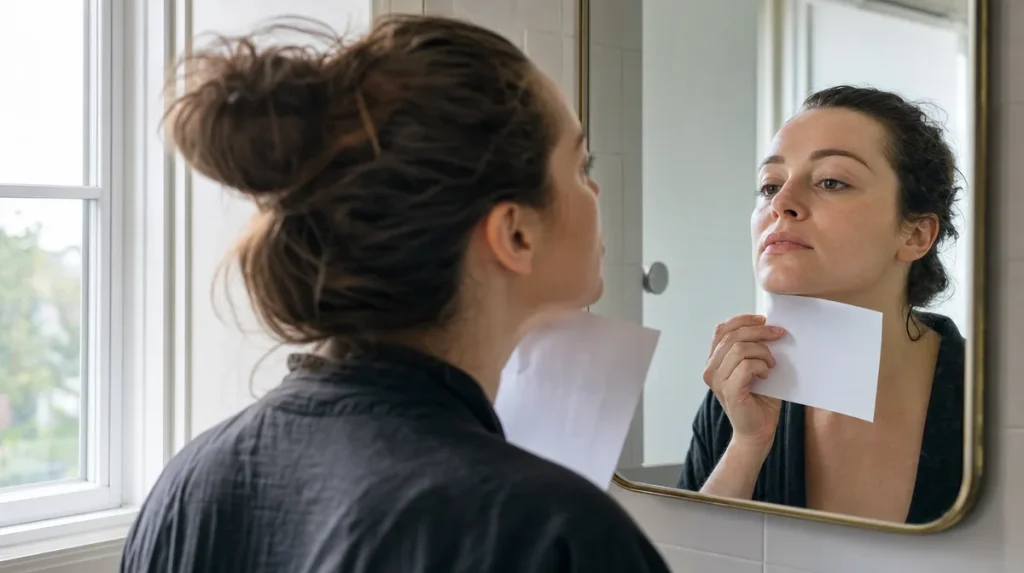
A quick self-test: hold a piece of white paper under your jaw in daylight. If your skin looks rosy against the white, you likely lean cool. If it looks golden or olive, you likely lean warm. This takes fifteen seconds and saves a return trip to the store.
What Full Coverage Actually Means, Mechanically

Coverage is a measure of opacity: how much of the skin’s own tone and texture gets blocked from view. Two foundations can claim “full coverage” and behave completely differently depending on how their pigments are ground and suspended.
Think of it the way you’d think about paint. A cheap wall paint needs three coats to hide a stain because the pigment particles are large and unevenly dispersed. A good-quality paint, milled finer and blended more precisely, covers the same stain in one coat because more of the surface area is doing the work of blocking light.
Foundation works the same way. Finely milled iron oxides and titanium dioxide, evenly suspended through the formula, scatter and absorb light efficiently, so a thin film provides real opacity. Coarser or unevenly dispersed pigment needs more product piled on to achieve the same effect, and that extra bulk is what tends to settle into pores and fine lines by midday.
This is also why price alone is not a reliable signal. Milling quality is a manufacturing detail, not a marketing one, and it rarely shows up on the label.
The Mistakes Almost Everyone Makes
The most common mistake is applying foundation with a dry sponge or brush, then adding more when the first layer looks patchy. Dry tools drag pigment unevenly and pull moisture from the formula as you blend, which speeds up how quickly it looks cakey.
A damp sponge, by contrast, lets the sponge absorb some product into its own moisture rather than the skin’s, and it deposits pigment more evenly across the surface. Dermatologists commonly note that skin’s natural texture, including fine lines and pores, becomes more visible when product is layered dry rather than blended with a damp tool.
Another frequent error is skipping a proper moisturizer underneath. Foundation clings to dry, flaking patches the same way paint clings unevenly to a poorly primed wall. It is not the foundation failing, it is the surface underneath.
Finally, people often apply too much around the nose and chin, the areas most visible in a mirror, and too little near the hairline and jaw, which creates a visible line of demarcation once the person steps into daylight or under different lighting.
Where Cheap Formulas Actually Cut Corners
Not every inexpensive foundation is poorly made, and not every expensive one is well made, but there are real, verifiable places where cost-cutting shows up.
One is pigment load: manufacturers can reduce the amount of iron oxide or titanium dioxide in a formula to cut cost, which means the product needs a heavier hand to achieve the same coverage claimed on the label.
Another is the oil-to-powder ratio in the base. A poorly balanced base can separate on the skin within a few hours, migrating into fine lines and leaving bare patches on the high points of the face. This is sometimes called “breaking down” and it is a formulation issue, not a sign the wearer did something wrong.
A third is the finishing agents that control shine. Cheaper silicone blends can create a flat, powdery look initially that turns patchy as the skin’s natural oils resurface later in the day. None of this means low-cost formulas are inherently bad. Some perform very well. But price alone tells you little, and a formula’s actual behaviour over an eight-hour day is the only honest test.
What Realistic Results Look Like, And When To Judge Them
A fair test of any foundation needs at least six to eight hours of ordinary wear, since most formulas shift during that window as skin oil, temperature, and movement interact with the product.
Judge a foundation at three points: right after application, around the four-hour mark, and at the end of the day. Early impressions are almost always flattering, since most formulas look their best in the first thirty minutes.
What should stay consistent is coverage in areas with visible redness or discoloration. What may reasonably change is shine, particularly through the T-zone, which is normal skin oil resurfacing rather than a sign the product has failed.
A formula that visibly separates into patches, cakes into fine lines, or oxidizes to a noticeably different shade within a few hours is showing you a real formulation limitation, not a fluke of that particular day. If that happens across multiple wears, it is worth trying a different formula type rather than a different shade of the same one.
Coverage Claims Versus What The Label Actually Tells You
Terms like “full coverage,” “medium-to-full,” and “buildable” are not regulated, so two brands can use the same word to describe very different formulas.
What is worth reading on a label is the ingredient list order, since ingredients are listed by concentration. If a pigment like titanium dioxide or iron oxide appears well down the list, after a long string of emollients and silicones, the formula likely relies more on the emollient base for its finish than on genuine pigment density for coverage.
Marketing language like “skin-like finish” or “second skin” describes texture and wear feel, not opacity, and the two are frequently confused by shoppers looking for a product that hides discoloration.
A simple self-test at the counter or in a store aisle: apply a small amount to the back of your hand where you have a visible vein or freckle, and see how much product it takes to obscure that mark. That single test tells you more about real coverage than any label claim.
Skin Type And How It Changes The Outcome
The same foundation can behave in opposite ways on different skin types, which is why a friend’s glowing review is not always transferable advice.
On oilier skin, a formula with a heavier emollient base tends to slide and separate faster, since the skin’s own oil adds to the oil already in the product. On drier skin, that same formula might wear beautifully for hours because there is less oil competing with it.
The Canadian Dermatology Association’s general public guidance on cosmetic use notes that individuals with oily or acne-prone skin often see better results from oil-free or water-based formulas, while those with dry skin may find more comfort in formulas built around emollients and humectants.
A short self-test: blot your T-zone with a tissue about two hours after your normal skincare routine, before any makeup. Visible oil on the tissue is a reasonable sign you would benefit from a lighter, oil-free base, while a dry tissue suggests your skin can handle a richer formula without breaking down early.
When Less Coverage Is The Better Choice
It is worth saying plainly that full coverage is not always the right goal, even on days when discoloration or blemishes feel more visible.
Heavier formulas sit differently over textured skin, including enlarged pores or fine lines, since a thick layer of product can settle into those recesses and make them more visible under certain lighting rather than less.
Many people find that targeted concealer over specific areas, combined with a lighter foundation or tinted moisturizer over the rest of the face, achieves a more natural-looking result with less product overall and less risk of a heavy, mask-like finish by the afternoon.
This is less about a rule and more about matching the tool to the actual problem. If the concern is one or two specific areas, spot coverage usually looks better than an all-over heavy layer.
Key Takeaways
Coverage depends on pigment quality and density, not the amount of product used. Matching undertone in daylight matters more than chasing an exact shade depth. A damp sponge and a properly moisturized base do more for a natural finish than extra layers of foundation. Judge any formula over a full day, not just the first thirty minutes, and remember that heavier is not always better, especially over textured skin.
A Quick Checklist Before You Buy
- Swatch three shades along the jaw and check the match in daylight, not store lighting.
- Blot your T-zone two hours after your skincare routine to judge whether your skin runs oily or dry that day.
- Test coverage over a visible vein or freckle on the back of your hand.
- Apply with a damp sponge rather than a dry one, over moisturized skin.
- Check the product at four hours and again at the end of the day before judging it fairly.
- Consider whether targeted concealer plus a lighter base might solve the actual problem better than an all-over heavy layer.
This article is intended for general information purposes and is not a substitute for advice from a qualified skincare professional.
Individual results vary depending on skin type, application method, and product formulation.