


Priya Sandhu, Staff Writer.
It is eleven at night, the mascara has not moved all day, and the only thing standing between you and bed is a bottle of pink liquid you bought because the label said gentle. Most of us own at least one half-used bottle of micellar water, bought on a whim, abandoned when it left a film or did nothing at all. The category is crowded, the marketing is loud, and almost none of it explains what the product is actually doing on your skin. Here is the useful fact to start with: micellar water does not clean the way soap does. It works by attraction, not friction, which is exactly why using it correctly, and knowing when to skip it, makes more difference than which bottle you pick.
- Micellar water lifts residue by attraction, not scrubbing, so pressing hard defeats the point and can irritate skin instead of cleaning it.
- A shorter, simpler ingredient list usually performs better than a long one, since extra botanicals and fragrance raise irritation risk without adding cleansing power.
- Rinsing or double cleansing after heavy makeup matters more than brand choice, because leftover surfactant residue is a common cause of next-day dullness and clogged pores.
What’s Actually Happening On Your Cotton Pad
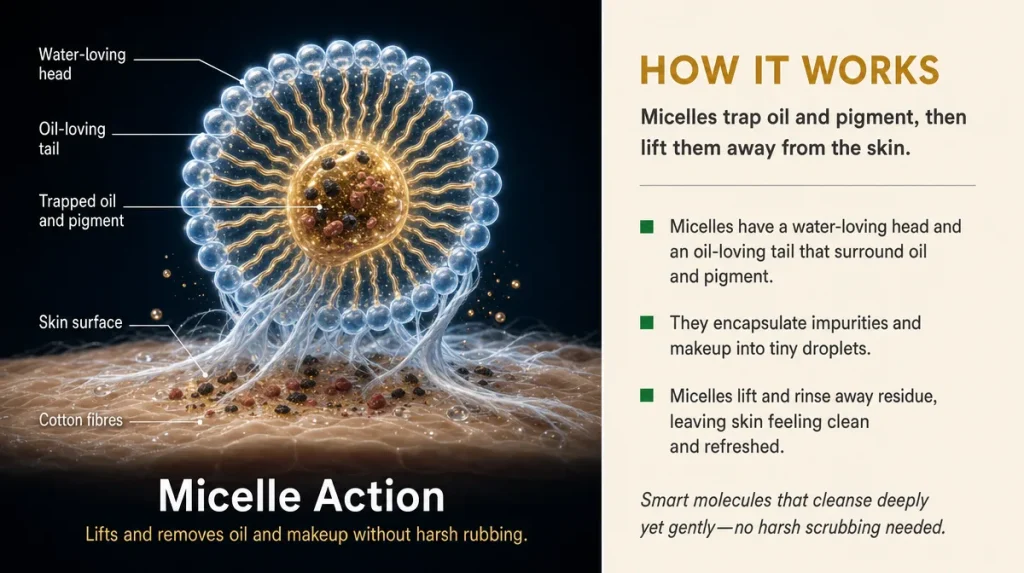
Micelles are tiny spheres formed when certain surfactant molecules meet water. Each molecule has an oil-loving tail and a water-loving head. In water, they arrange themselves into a ball, tails pointing inward, heads facing out. Sebum, makeup pigment, and sunscreen residue get pulled into that oily centre and carried away when you wipe or rinse.
Think of dish soap in a sink full of warm water. You do not need to scrub a greasy pan raw once the soap has gathered the fat into little clusters that lift off with a light pass of the sponge. Micellar water is built on the same principle, at a concentration gentle enough for facial skin.
A review published in the International Journal of Cosmetic Science described micellar formulas as combining low-irritant surfactants with humectants, which is why they can lift makeup with less friction than a washcloth and soap. That is also their limit: they are designed to lift, not to deep-clean pores the way a foaming cleanser or a proper rinse does.
Reading The Label Without A Chemistry Degree
Most shoppers scan a micellar water label the way they scan a wine list: for a word that sounds trustworthy. That is not a reliable method here.
What matters: a mild surfactant system, often listed as poloxamer or a polysorbate, a low fragrance load or none, and a pH close to that of skin, generally slightly acidic. These details rarely appear in bold on the front of the bottle, so it helps to flip it over.
What is mostly marketing: long lists of botanical extracts positioned near the bottom of the ingredient list, where their concentration is often too low to do much. Words like detoxifying or purifying describe a feeling more than a mechanism, since skin does not accumulate toxins that a liquid wipes away.
A simple self-test: if a formula stings, tingles, or leaves your skin tight within a minute, the fragrance or alcohol content is likely too high for daily use on your face, whatever the label promises.
The Wipe And Rinse Method, Step By Step
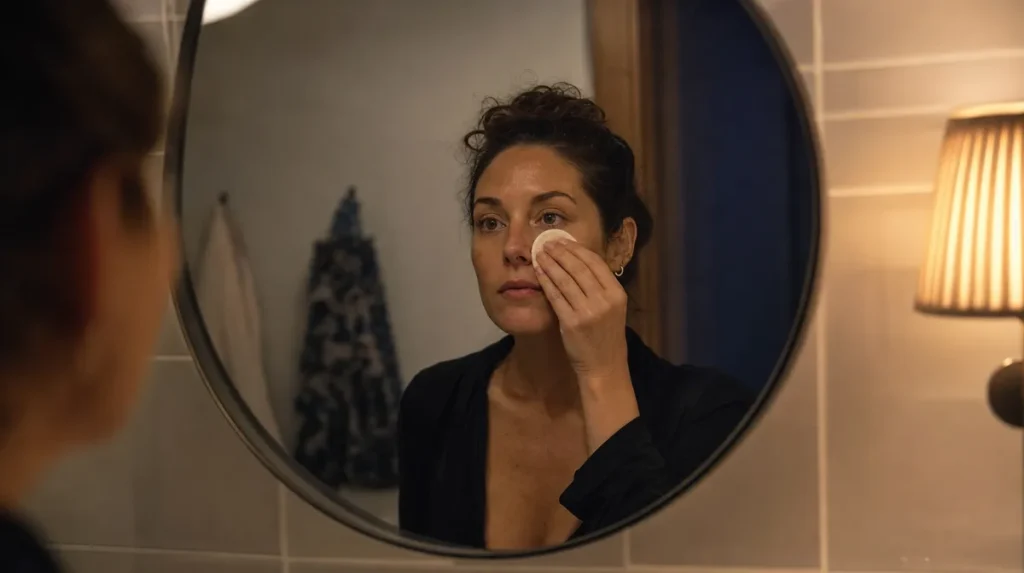
Saturate a cotton pad generously. A pad that is only half wet drags rather than glides, which is what leads to the over-rubbing that irritates skin.
For eye makeup, hold the pad against closed lids for five to ten seconds before sweeping. This gives the micelles time to surround mascara and liner rather than forcing you to scrub them off.
Sweep once in one direction per area, not back and forth. If the pad still shows heavy colour transfer, use a fresh pad rather than continuing with a dirty one, which just redistributes what you already removed.
Finish with a rinse, or a short pass with your regular cleanser, particularly if you wore sunscreen or long-wear foundation. Micellar water is a first step for many people, not always the last one.
When Micellar Water Is The Wrong Tool
Waterproof mascara, long-wear foundation, and mineral sunscreen are formulated to resist water and light friction, which is precisely what makes them hard for micellar water to fully lift on its own.
For these, a cleansing oil or balm massaged in before any water-based step tends to work better, because oil dissolves oil-based film-formers more completely than a micellar solution can on a single pass.
A common mistake is using more micellar water and more pressure when a formula will not budge, rather than switching tools. That extra rubbing is where irritation and broken capillaries around the eyes usually start, not from the product itself.
If you find yourself using half a bottle to remove one full face of makeup, that is a sign to add an oil-based first step rather than a sign you need a stronger micellar formula.
The Double Cleanse Question
Double cleansing means an oil-based first step followed by a water-based second cleanse. It is not a marketing invention. It solves a real chemistry problem: oil-soluble residue and water-soluble residue do not lift equally well with a single product.
On days with heavy makeup or mineral sunscreen, a two-step approach removes more residue with less scrubbing than trying to force one product to do both jobs.
On bare-faced days, or days with only light tinted moisturizer, a single pass with a gentle cleanser is enough. Doubling up unnecessarily can strip the skin barrier over time, an outcome public guidance from bodies such as the Canadian Dermatology Association has cautioned against when discussing over-cleansing generally.
The practical rule: match the number of cleansing steps to what is actually on your face that day, not to a routine you read about once and never questioned again.
Judging Results: What Clean Skin Should Feel Like
Clean does not mean squeaky. A tight, stretched feeling after cleansing usually signals that the skin barrier has been stripped of natural oils, not that your face is finally free of dirt.
A simple test: after your usual routine, sweep one fresh white cotton pad over your cheek and forehead. Light tinting is normal, since some residual pigment from foundation or concealer often remains even after correct removal. Heavy colour transfer means you likely need a second pass or a different first step for that day’s makeup.
Results with micellar water are immediate, unlike a treatment product you judge over weeks. If your skin looks visibly clean and feels comfortable within a minute of finishing, the method and formula are working for you. If it still feels filmy or tacky, the formula may be leaving surfactant residue behind, which argues for a rinse afterward rather than a stronger product.
The Mistakes Almost Everyone Makes
Rubbing hard is the most common one. It comes from a reasonable but mistaken belief that friction equals cleanliness, when the micelles are doing the actual lifting work.
Skipping the hold-and-wait step over eye makeup is another. Long-wear formulas need those five to ten seconds of contact time, not an immediate wipe.
Using the same side of a cotton pad across the whole face spreads removed makeup and bacteria rather than lifting it away, which can contribute to clogged pores along the jaw and hairline.
Skipping the rinse after a heavily fragranced or alcohol-based formula leaves residue on skin overnight, which a 2019 study in Contact Dermatitis linked to a higher rate of mild irritation among regular users who never rinsed. None of these mistakes require a new product to fix, only a slower, more deliberate version of the same routine.
Sensitive Skin, Eyes, And Contact Lens Wearers
If your skin reacts easily, patch test any new formula on the inside of your forearm for two consecutive days before using it near your eyes, a precaution consistent with general public guidance from the Canadian Dermatology Association on introducing new skincare products.
Contact lens wearers should remove lenses before using any eye makeup remover, since surfactants and fragrance ingredients can transfer to lenses and cause irritation later in the day.
Fragrance-free formulas cost you nothing in performance, since fragrance plays no role in the micelle’s ability to lift oil and pigment. It is added for scent alone, which makes it one of the easiest ingredients to remove from your shortlist if your skin is reactive.
For the eye area specifically, a lower alcohol content matters more than any other single spec on the label, since alcohol evaporation is a common cause of stinging on thin eyelid skin.
Key Takeaways
Micellar water lifts, it does not scrub, so let it sit for a few seconds before wiping rather than pressing harder.
A shorter ingredient list with a mild surfactant and little or no fragrance tends to outperform a long, botanical-heavy one.
Heavy or waterproof makeup usually needs an oil-based first step, with micellar water or a gentle cleanser as the second.
Rinse or follow with a proper cleanse after heavy makeup days to avoid leftover residue overnight.
Judge results by comfort and a light cotton-pad test, not by how tight your skin feels afterward.
A Quick Checklist Before You Reach For The Bottle
- Check the ingredient list for a mild surfactant and low or no fragrance
- Match your cleansing steps to what is actually on your face that day
- Hold the pad over eye makeup for five to ten seconds before wiping
- Use a fresh pad once the first one is visibly saturated with makeup
- Rinse or double cleanse after sunscreen or long-wear products
- Patch test new formulas before using them near the eyes
- Remove contact lenses before using any eye makeup remover
This article offers general information and is not a substitute for advice from a dermatologist or other qualified health professional.
Individual skin response varies, and results described in this guide may not apply to everyone.