


Robert Halloway, Senior Health and Science Editor.
The lipstick that promised twelve hours of wear is sitting half-used in a drawer, the colour patchy by lunch and gone by dinner. Most women have a version of this drawer: three or four long-wear formulas bought on faith, each abandoned for the same reason. The label spoke of hours and coffee cups and kisses, and the mirror told a different story by early afternoon. This guide is for the reader who wants to stop guessing at the counter. One useful fact to start: the wear time printed on a lipstick box usually comes from controlled lab conditions, sometimes static lip moulds, not from a mouth that talks, eats and drinks through an ordinary workday. Consumer-testing publications such as Protégez-Vous have periodically flagged the gap between laboratory wear claims and real-world use. By the end of this piece, you will be able to read a lipstick’s ingredient list in under a minute, run a simple wear test at home before committing to a full tube, and tell which claims describe chemistry and which describe copywriting.
- Film, not paint: long-wear colour holds through a thin polymer film that bonds to the lip surface, which is why it behaves nothing like an ordinary lipstick, in application or in removal.
- Undertone matters more here than usual: because the film sets fast and resists blending, a slightly wrong shade stays slightly wrong for hours rather than softening over time.
- Test it yourself before you trust the box: a simple at-home wear check across a few hours tells you more than any packaging claim, since standardized lab tests rarely reflect eating, drinking or talking.
What Long-wear Actually Means On Your Lips
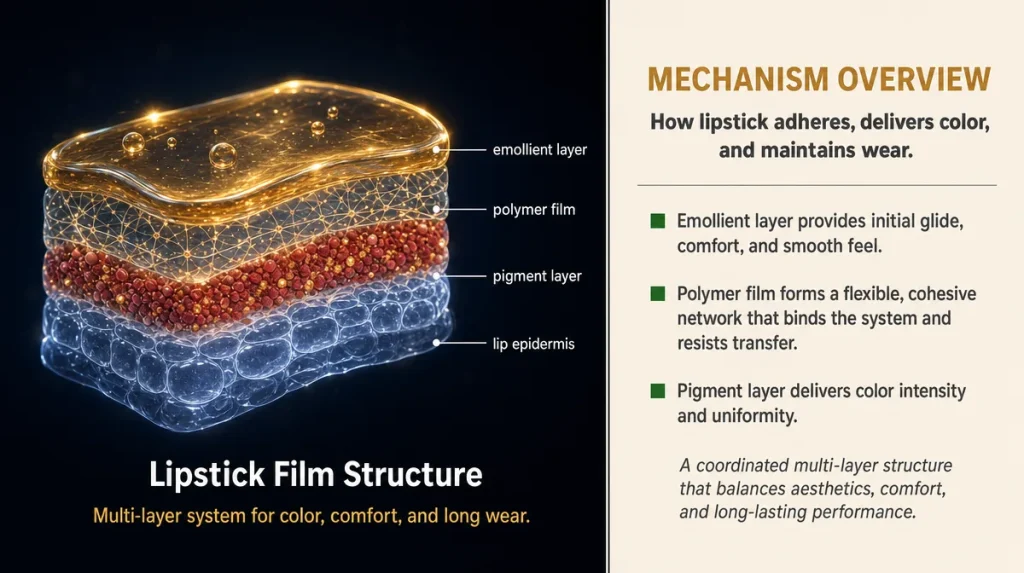
Ordinary lipstick sits on the lip surface much like a coat of interior wall paint: pigmented, pleasant, and easily wiped away with a damp cloth. Long-wear formulas work more like exterior deck stain. They are built around film-forming polymers, ingredients that dry down into a thin, flexible layer that grips the skin rather than sitting on top of it.
That film is what survives a coffee cup and a lunch. It is also why long-wear lipstick often applies wet and then sets matte within a minute or two: the solvent carrying the pigment evaporates, leaving the polymer and colour behind, bonded to the lip.
A 2019 study in the International Journal of Cosmetic Science measured transfer resistance across several film-forming lip formulas and found that wear time correlated most closely with polymer content, not with pigment load or wax percentage, contrary to what many shoppers assume when they equate a thicker application with longer wear.
Understanding this mechanism changes what you look for on a label. A lipstick advertised as long-wear but built mostly on waxes and oils, with no film-forming agent listed near the top of the ingredient list, is unlikely to perform as promised, whatever the packaging says.
Finding Your Undertone In Daylight
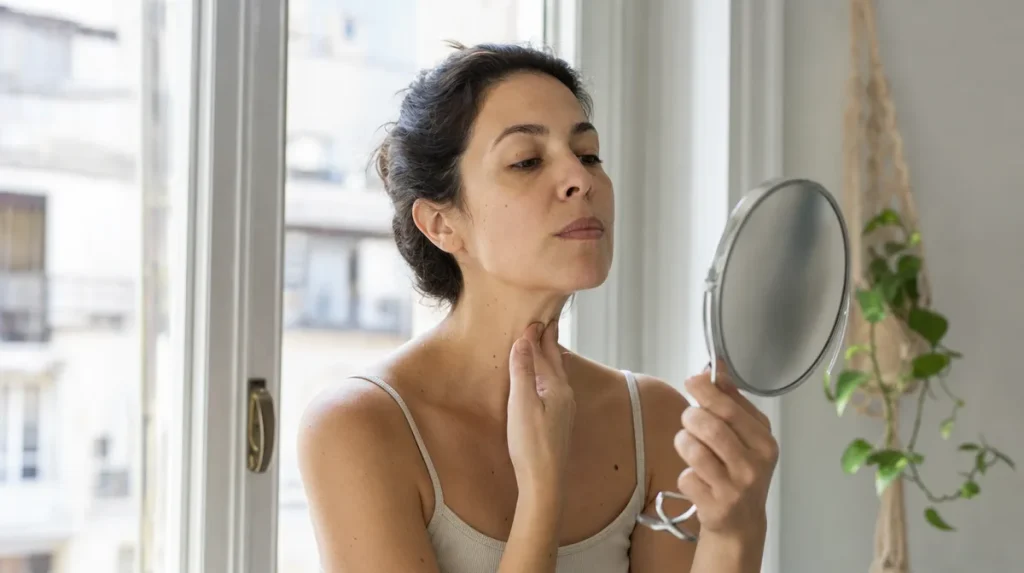
Store lighting is the enemy of an accurate colour match. Most fitting rooms and beauty counters use warm, yellow-toned bulbs that flatten the natural variation in skin, which is why a lipstick that looked perfect under those lights can look chalky or orange the moment you step outside.
The fix is simple and free. Stand near a window with natural daylight, without direct sun on your face, and look at the underside of your wrist. Bluish or pink veins generally point to a cool undertone; greenish veins suggest warm; if you genuinely cannot tell, you likely lean neutral, which is the most common category and the most forgiving for lipstick shopping.
A quicker test: hold a swatch of gold jewellery and a swatch of silver against your jawline in daylight. Most people find one visibly more flattering, brightening the skin rather than sitting flat against it. Gold tends to favour warm undertones, silver tends to favour cool ones.
Undertone matching matters more for long-wear formulas than for sheer, buildable ones, because a long-wear film sets quickly and is harder to blend or soften once dry. A shade that is slightly off will stay slightly off for hours, not fade into something more flattering the way a gloss might.
Beauty editors at ELLE Canada and The Kit have both noted, in seasonal colour guides, that swatching on the wrist rather than the back of the hand gives a closer approximation of lip tone, since lips carry more blood flow and less melanin than most areas of skin.
Reading The Ingredient List Without A Chemistry Degree
Lipstick ingredient lists look intimidating, but a long-wear formula only needs to answer a few questions.
Is there a film-former near the top of the list? Look for names like trimethylsiloxysilicate, VP/VA copolymer, or isododecane. Their position matters: ingredients are listed by concentration, so a film-forming agent buried near the bottom is doing very little work.
Is there any emollient at all? Genuinely bare long-wear formulas, with no oil, ester, or silicone to soften the film, are the ones most likely to feel tight or flaky by the afternoon. A short list that includes an ester like isopropyl myristate or a plant oil suggests the formula was built with comfort in mind, not just staying power.
What pigment system is used? Iron oxides tend to behave more predictably across skin tones and light than some synthetic dyes, and they are common in longer-wearing formulas because they resist fading under UV exposure better than dye-based colour.
None of this requires memorizing chemistry. It requires five seconds spent on the back of the box, checking whether the first ten ingredients include at least one film-former and at least one emollient. If a label leans entirely on marketing language, terms like locking technology or a ten-hour complex, without a single recognizable film-forming ingredient near the top, treat the wear claim with some skepticism.
Why Long-wear Formulas Can Dry Out Lips, And How To Judge If Yours Does
The same film that resists a coffee cup also resists moisture moving in both directions. Lips have no oil glands of their own, unlike the rest of the face, so they depend entirely on external products and on moisture rising from underlying tissue. A polymer film that is too occlusive can trap that moisture beneath it initially, then, as the solvent finishes evaporating over the following hour, pull residual moisture out of the surface layer along with it, leaving lips feeling tight.
Think of it the way a raincoat behaves in heat: waterproof enough to keep rain out, but if it does not breathe, sweat builds up and evaporates all at once, leaving you colder than if you had worn nothing.
To judge whether a formula is drying for you specifically, apply it to clean, bare lips and check in at two points: twenty minutes, when the initial set is complete, and three hours later. Tightness at twenty minutes that eases is normal film formation. Tightness that increases, along with visible flaking at the three-hour mark, points to a formula whose polymer-to-emollient ratio does not suit your lips.
Dermatologists writing in Canadian outlets, including columns in Chatelaine and Canadian Living, have generally advised applying a hydrating balm and letting it fully absorb for several minutes before any long-wear colour, rather than applying colour to lips that are already dry, since the film will seal in whatever condition the lips are already in.
Mistakes Everyone Makes Applying Long-wear Colour
The most common mistake is applying long-wear lipstick to unprepared lips, expecting the formula to smooth over texture the way a regular lipstick might. It will not. Because the film dries thin and matte, it actually reveals dry patches and flaking more than it hides them.
The second mistake is over-application in an attempt to guarantee coverage. Long-wear formulas are built to be applied in a single, deliberate layer. A second heavy layer before the first has finished setting often causes the film to crack or ball up, particularly at the centre of the lip, where movement is greatest.
The third mistake is skipping a liner. A long-wear film that ends abruptly at the lip line, with no liner to soften the edge, tends to show its border more obviously as the day wears on, since the colour inside the line fades unevenly against skin that was never coloured.
The fourth, and most damaging, is trying to remove long-wear lipstick with a quick wipe. Because the polymer bonds to the surface, wiping alone tends to pull at the delicate skin rather than lifting the colour cleanly, which over repeated use can leave lips looking rougher over time. A gentle oil-based remover, left to sit for a few seconds before wiping, breaks the film’s bond without the friction.
What Counts As Real Staying Power, And What’s Marketing
Certain claims on lipstick packaging describe something measurable. Transfer-resistant generally means the formula has been tested against a fabric or glass surface for pigment transfer under a specified pressure, a standard method used across the industry. Water-resistant similarly implies a defined test, often involving contact with water for a set period.
Other phrases describe nothing in particular. All-day wear, kiss-proof and budge-proof have no standardized definition and can mean whatever a brand’s marketing team decides they mean. That does not make the product bad; it means the claim tells you nothing you can rely on without trying the formula yourself.
Consumer-testing groups, including Protégez-Vous in Québec, have periodically tested cosmetic wear claims against advertised times and found meaningful variation between brands making similar promises, underlining that a claim printed on a box is a starting point for expectations, not a guarantee.
A practical rule: claims tied to a specific test method, transfer, smudge, water contact, tend to be verifiable and somewhat trustworthy. Claims tied to a duration in hours, especially round numbers like eight, ten or twelve, are almost never based on a standardized method that reflects eating, drinking or talking, and should be treated as marketing shorthand rather than a lab result.
Running Your Own Wear Test Before You Commit
A five-minute in-store swatch tells you almost nothing about how a lipstick will behave over a full day. The only reliable test happens at home, ideally before you commit to wearing a colour out.
Apply the lipstick as you normally would, then go about an ordinary few hours: have a coffee, eat a meal, talk on the phone. Check the colour at four points: immediately after application, after twenty minutes, after your first meal or drink, and again after three to four hours.
Note where it fades first. Colour that fades from the centre of the lower lip usually points to a formula that does not hold up to contact with food and drink. Colour that fades evenly, growing lighter overall rather than patchy, usually indicates the film is simply thinning with time, a more predictable and generally more flattering kind of wear.
Photograph each check-in under the same lighting if you want an objective record rather than relying on memory, since perception of your own lip colour shifts through the day. Keep a short note of which formulas passed this test and which did not. Over a few months, this record becomes more useful than any counter advice, because it reflects your specific habits: how much you drink, how often you eat, how much you touch your face.
Caring For The Lips Underneath The Colour
Long-wear lipstick performs best on lips that are already in reasonably good condition, and the reverse is also true: repeated use of drying formulas without any recovery time gradually worsens the texture the lipstick then has to sit on.
A simple rotation helps. On days without long-wear colour, or at night, apply a plain occlusive balm, ideally one built around ingredients like petrolatum, lanolin or shea butter, which studies on lip barrier repair have generally found more effective at reducing water loss than flavoured or tinted balms with added fragrance.
Gentle exfoliation, no more than once or twice weekly, using a soft cloth or a mild sugar-based scrub, removes the flaking that long-wear formulas otherwise cling to and exaggerate. Avoid exfoliating right before applying colour, since freshly exfoliated skin can be slightly more reactive to pigments and polymers for an hour or so afterward.
The Canadian Dermatology Association’s general public guidance on lip and skin care recommends checking for persistent cracking, bleeding or swelling that does not resolve with regular balm use, since these can indicate an allergic reaction to a specific ingredient rather than ordinary dryness, and are worth discussing with a health care provider rather than working around with more product.
Key Takeaways
Long-wear lipstick is a different category of product from ordinary colour, built around a polymer film rather than a simple pigmented balm. It rewards a bit of preparation: matching undertone in daylight, reading past marketing language on the label, prepping lips before application, and removing colour gently rather than wiping it away. No box claim, however specific the hour count, replaces a short wear test done on your own lips under your own daily habits.
A Quick Checklist Before You Buy
- Check the first ten ingredients for a film-former and at least one emollient
- Swatch on the wrist in natural daylight, not under store lighting
- Prep lips with a hydrating balm and let it absorb fully before applying colour
- Apply in one deliberate layer rather than building up thickness
- Line lips if you want the colour edge to hold evenly through the day
- Run a home wear test across a coffee, a meal and a few hours before wearing a new shade out
- Remove with an oil-based remover, not a quick wipe
- Give lips a recovery day with a plain balm between long-wear applications
This article is general information and does not replace advice from a dermatologist or other qualified health care provider.
Individual results vary and depend on skin type, application technique and daily habits.