

Melissa Grant, Beauty Editor.
You are standing at a counter with four testing strips drying in your hand, and all four smell roughly the same: pleasant, a little sweet, gone in your memory by the time you reach the parking lot. At home, the dresser tells a different story. Half a dozen bottles, each with an inch or two left, each bought for a reason you can no longer quite remember. The question you actually want answered is not “which one smells nice right now” but “which one will I still want to wear in a year.”
Here is the fact that changes how most people shop: the first impression of a fragrance, the one you get from a paper strip or a quick spray at a counter, is dominated by top notes that are designed to evaporate within fifteen to twenty minutes. What is left after that, the part that actually lives on your skin for the rest of the day, is a different scent entirely. Shopping by first sniff is a bit like choosing a car by its new-car smell.
This guide walks through what is genuinely worth paying attention to when you choose an eau de parfum, what is packaging and marketing language doing very little chemical work, and how to test a fragrance the way someone who works with scent for a living actually does it.
- The first ten minutes lie. Top notes are built to impress instantly and vanish fast, so judging a fragrance at the counter tests the part that matters least for daily wear.
- Concentration labels describe oil percentage, not quality. Eau de parfum sits above eau de toilette in oil content as a rule of thumb, but formulation and skin chemistry matter more than the label word.
- Your skin is part of the formula. The same fragrance can read sweeter, sharper or fainter on two different people, which is why testing on paper and testing on skin can give you contradictory answers.
Why The Counter Spray Tricks Almost Everyone

A fragrance is not one scent, it is a sequence. Perfumers build it in three loose stages: top notes that read within the first few minutes, heart notes that settle in over the next hour, and base notes that can still be faintly present after six or eight hours. Think of it the way you’d think of a three-course meal rushed onto one plate: the appetizer is what hits you first, but it is not what you remember the meal by.
Top notes are usually citrus, light florals or green aromatic materials, chosen partly because they are volatile: they evaporate quickly and announce themselves. That is useful in a shop, where a brand has about four seconds to catch attention, and nearly useless for predicting how the fragrance will behave on your collar at six in the evening.
The mistake almost everyone makes is deciding at the counter, in the first thirty seconds, based entirely on the part of the fragrance built to disappear. A 2021 study in Chemical Senses noted that odour perception and preference judgments shift meaningfully as a scent moves through its evaporation stages, which is a formal way of saying your nose is being asked to judge a book by a cover that changes.
The Skin Test That Actually Tells You Something
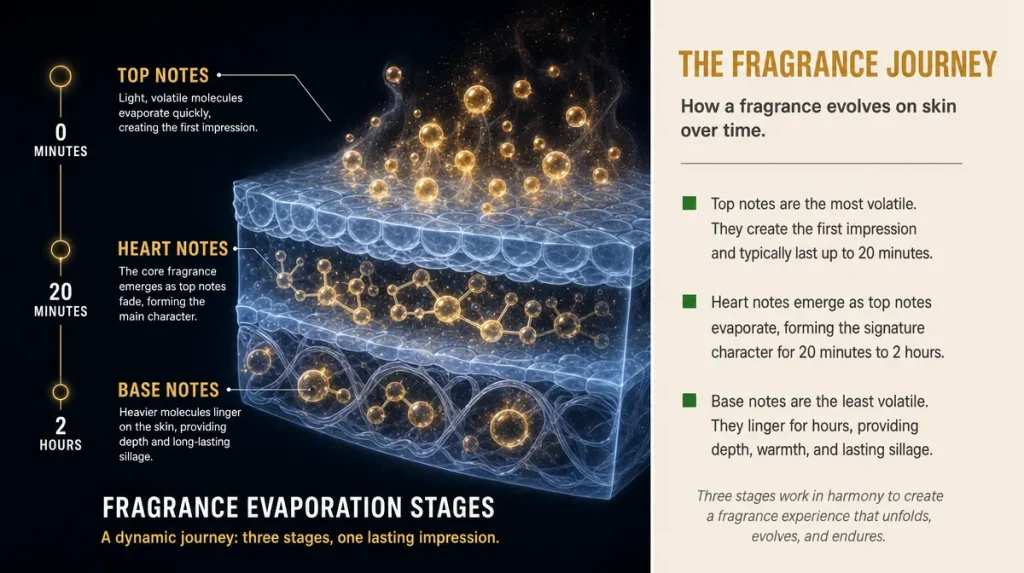
Spray a fragrance on your own skin, preferably the inside of your wrist or inner elbow, and then do not smell it again for twenty minutes. This single habit separates people who end up loving their fragrance from people who end up with a drawer of regrets.
After twenty minutes, the top notes have largely burned off and you are smelling something closer to the heart of the composition. Smell it again at the two-hour mark if you can manage it. That third check tells you about the base: whether it has gone warm and woody, thin and soapy, or disappeared altogether.
Do this with no more than two or three fragrances in a single outing. Your olfactory receptors fatigue quickly, a phenomenon sometimes called nose-blindness, and by the fourth or fifth strip you are no longer smelling distinct scents so much as a blur. Perfume counters that let you sniff coffee beans between strips are using a real trick: coffee’s strong, simple aromatic profile helps reset your sense of smell faster than plain air does.
What “Eau De Parfum” Actually Promises, And What It Does Not
The words on the bottle, eau de parfum, eau de toilette, eau fraîche, describe a rough band of fragrance oil concentration diluted in alcohol and water. As a general guide, eau de parfum sits around 15 to 20 percent oil, eau de toilette closer to 5 to 15 percent, though houses vary these ranges and are not required to publish exact figures.
A higher concentration tends to mean the scent lasts longer on skin and projects further, which is why eau de parfum is often marketed as the more premium, longer-wearing option. That is generally true, but it is not a guarantee of quality. A poorly blended eau de parfum can smell flat or synthetic despite the higher oil content, while a well-constructed eau de toilette can outlast it in practice because of how its particular materials behave on skin.
Treat the concentration label as one data point, not a verdict. It tells you roughly how much fragrance oil you are paying for, not whether that oil was blended with skill.
Where Inexpensive Fragrances Actually Cut Corners
Cost in fine fragrance is driven heavily by raw materials. Natural extracts, rose absolute, sandalwood oil, orris root, are expensive and variable harvest to harvest, which is one reason many mass-market fragrances lean on synthetic equivalents: they are consistent, cheaper, and in some cases genuinely good substitutes.
The real corner-cutting usually shows up in two places. First, in the base notes, which are meant to be the slow-release, long-lasting foundation of a scent. Cheaper formulations sometimes thin these out, which is why a budget fragrance can smell lovely for the first hour and then go nearly silent by hour three. Second, in what perfumers call the blend’s complexity: a composition with eight or ten well-chosen materials reads as rounded and evolving, while one built from three or four can smell one-dimensional, the way a soup made with only salt and pepper tastes flatter than one built on a proper stock.
This is not a case for assuming expensive always means better. Price also reflects packaging, marketing spend and brand positioning, none of which affect how a fragrance smells on your skin. It is a case for smelling past the first impression and paying attention to how a scent holds up after two or three hours, regardless of what it costs.
Reading An Ingredient List Without A Chemistry Degree
Fragrance ingredient lists are notoriously unhelpful to read, partly because many jurisdictions allow the word “fragrance” or “parfum” to stand in for a proprietary blend that can legally contain dozens of individual materials without each being named. This is standard industry practice, not a red flag specific to any one brand.
What you can look for: the presence of named essential oils or absolutes near the top of an ingredient list suggests the brand is using real botanical materials rather than relying entirely on synthetic replication, though synthetics are not inherently inferior and are often more stable and less likely to trigger a skin reaction.
If you have sensitive skin or a known fragrance allergy, Health Canada requires that certain known allergens be disclosed on cosmetic labelling above a concentration threshold. Checking for those disclosures matters more for comfort and safety than trying to decode the full ingredient list for quality.
Why The Same Bottle Smells Different On Your Best Friend
Skin chemistry is not a myth invented to sell more bottles, it is a documented variable. Factors including skin pH, natural oil production, diet and even the skin care products layered underneath a fragrance can all shift how the volatile materials in a scent evaporate and combine with your own body’s chemistry.
A 2019 paper in Flavour and Fragrance Journal found measurable differences in how identical fragrance compounds were perceived across subjects with differing skin oil levels, which helps explain why a fragrance that smells powdery and soft on one person can read sharper or sweeter on another.
This is the practical argument for always testing on your own skin rather than trusting a friend’s recommendation at face value, or judging a fragrance purely from how it smells on a paper strip. Paper has no oil, no pH, no warmth. It is a reasonable first filter for ruling scents out quickly, but a poor final judge.
Layering, Climate And The Mistakes That Shorten Wear Time
Fragrance performs differently depending on skin hydration and ambient humidity. Dry skin has fewer oils to help trap and slow-release fragrance molecules, which is one reason fragrance seems to fade faster in winter or on very dry skin types. A simple, well-supported habit: apply an unscented or lightly scented moisturizer to pulse points before spraying. The slightly oilier surface gives the fragrance something to hold onto.
A common mistake is rubbing wrists together after applying, a habit many people pick up without thinking. This generates friction heat, which can break down some of the more delicate top-note molecules prematurely and subtly distort the fragrance’s intended opening sequence. Letting a fragrance dry undisturbed preserves the sequence as the perfumer built it.
Another frequent error is over-application in the belief that more product means longer wear. Past a certain point, additional sprays increase intensity and the radius at which others can smell you, known in the industry as projection or sillage, but do not meaningfully extend how long you personally will still detect the scent, since your own nose adapts to a familiar smell within minutes regardless of concentration.
A Five-minute Self-test Before You Buy
Before committing to any fragrance, Canadian consumer guidance from groups such as Protégez-Vous has historically encouraged shoppers to compare products methodically rather than on impulse, a principle that applies neatly here. Try this sequence at the counter or at home with a sample: spray once on skin, wait twenty minutes without smelling it again, then ask three questions. Does it still smell appealing, or has it gone sharp or synthetic. Can you still identify it at arm’s length, or has it nearly vanished. Does it still feel like something you’d want near your face eight hours from now.
If you answer yes to at least two of those after the twenty-minute wait, the fragrance has passed the only test that actually predicts long-term satisfaction. If you only like it in the first few minutes, you have found a nice-smelling paper strip, not necessarily a fragrance worth owning.
Key Takeaways
A fragrance is a sequence, not a single impression, so judge it after twenty minutes and again after two hours, never at first spray alone. Concentration labels like eau de parfum describe oil percentage as a rough guide, not a quality guarantee. Price often reflects the complexity and quality of base notes more than the front-of-bottle marketing suggests. Your own skin chemistry changes how any fragrance performs, which is why testing on paper is a filter, never a final answer. Simple habits, moisturizing bare skin before spraying and letting a fragrance dry undisturbed, do more for longevity than buying a stronger concentration.
Quick Checklist Before You Buy
- Test on skin, not paper, whenever a final decision is on the line
- Wait twenty minutes before judging, then check again at the two-hour mark
- Test no more than two or three fragrances in one outing to avoid nose fatigue
- Moisturize pulse points first if your skin runs dry
- Let the fragrance dry undisturbed rather than rubbing wrists together
- Check the label for disclosed allergens if you have sensitive skin
- Remember that a higher price does not automatically mean a better blend
This article is for general information only and does not replace individual advice from a qualified professional.
Individual results and perception of fragrance can vary from person to person.