
Owen Bellefeuille, Features Reporter.
You catch your reflection in the hallway mirror on a Wednesday morning and there it is: the part line looks flat, almost shiny, and the roots have that particular heaviness that no amount of finger-fluffing fixes. On the shelf behind you sit three half-used cans of dry shampoo, each one bought after the last one seemed to stop working. Most people assume the product failed. Usually it did not. Dry shampoo does not clean hair the way water and surfactant do. It works by coating oil with a fine starch or clay that absorbs sebum and scatters light differently, so strands look matte instead of slick. That single mechanical fact explains almost every mistake people make with the can, and almost every fix.
- Timing beats quantity: applying dry shampoo the night before, onto roots that already have some natural oil to grip, works better than a heavy morning spray on dry, freshly washed hair.
- Distance and brushing decide the finish: holding the can too close and skipping the brush-out is the single biggest reason dry shampoo looks powdery instead of invisible.
- Buildup is not the same as dirt: scalp flaking after repeated use often signals product residue rather than uncleanliness, and calls for a clarifying wash, not more spray.
Why The Second-day Smell Comes Back By Noon

Sebum is not a static coating. Glands at the base of each follicle keep producing oil through the day, and dry shampoo only manages what is already on the strand at the moment you spray it. Think of it like blotting paper on a leaking pen: it soaks up the ink that has already pooled, but it cannot stop the pen from leaking again an hour later.
This is why a single morning application can feel spent by early afternoon, especially along the crown, where oil glands tend to be more active. Reapplying lightly at midday, focused only on the areas that have gone flat, does more good than a second full pass over the whole head.
A quick self-test: press a clean tissue against your part line before you leave the house and again at noon. If the tissue picks up visible oil by lunchtime, your scalp runs on the oilier side and will need a light midday touch-up regardless of which product you use.
The Distance And Angle That Actually Matter
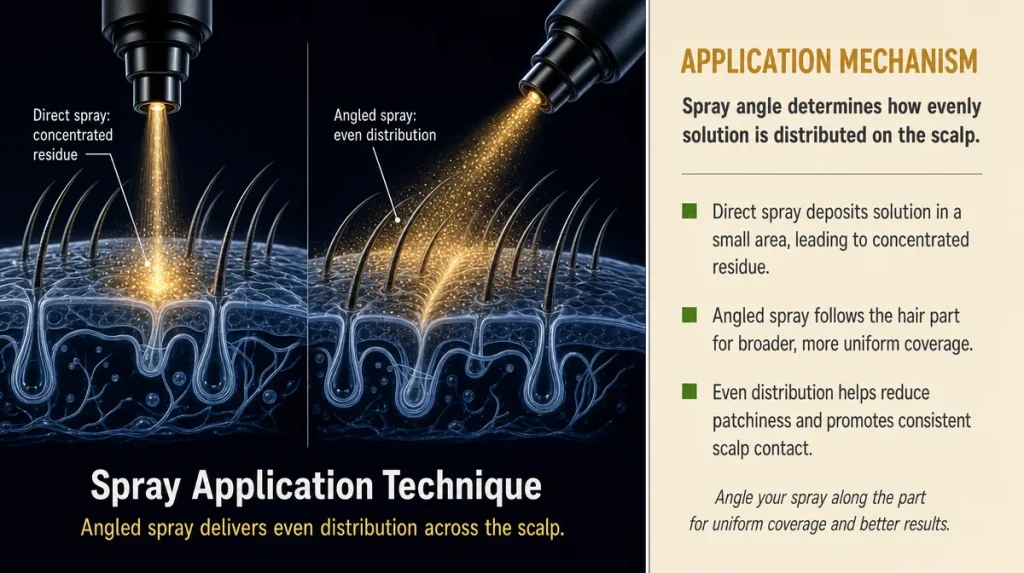
Most instructions say to hold the can six to eight inches from the scalp, but the detail that gets skipped is the angle. Spraying straight down concentrates powder in one spot and is the main reason for that pale, ashy cast at the roots. Angling the nozzle slightly, so the mist travels along the part rather than straight into it, spreads the product across more surface area with less of it landing in any single place.
Section the hair in two-to-three-centimetre strips along the part, spray once per strip, then move to the next section. Going back over the same strip twice is a common reflex, and it is almost always unnecessary.
A household comparison helps here: it is the difference between dusting icing sugar over a whole cake with a sifter versus dumping a spoonful in the centre. Same amount of sugar, very different result.
Spraying At Night Instead Of In The Morning
Beauty editors at Chatelaine have long pointed out that dry shampoo behaves differently depending on when it goes in, and the underlying reason is simple chemistry. The starch particles need some oil to bind to. Apply the product to hair that is completely clean and dry, and there is nothing for the powder to grip, so it sits on top of the strand and can look chalky.
Applying it the night before, once the scalp has had several hours to produce a light layer of natural oil, gives the starch something to absorb and blend into rather than just coat. By morning, brushing distributes both the absorbed oil and the residual powder together, and the result tends to look more like clean hair and less like hair with something dusted onto it.
This does not mean skipping washing altogether. It means treating dry shampoo as a maintenance step between washes rather than a substitute for one.
Brushing Out Is Half The Job
Spraying is only step one. A 2019 study in the Journal of Cosmetic Science examining starch-based hair powders found that mechanical distribution, meaning brushing, changed how visible the residue was far more than the formula itself did. In practice, that means a two-minute wait after spraying, followed by brushing from root to tip with a natural-bristle or boar-bristle brush, matters as much as which can you bought.
The waiting period lets the propellant evaporate and the starch settle before you disturb it. Brushing immediately, while the spray is still wet, tends to smear the powder rather than distribute it.
People with fine hair often skip the brush-out because they worry about flattening volume. The opposite tends to happen: unbrushed powder sits in visible clumps near the scalp, which reads as heavier, not lighter. A boar-bristle brush, run in long strokes, picks up excess powder and redistributes natural oils down the length of the hair at the same time, doing two jobs in one pass.
Matching The Shade To Your Roots
Tinted dry shampoos exist because plain white starch is genuinely visible against dark hair, and this is one area where reading the fine print helps more than trend-chasing. A shade that is close to your root colour, rather than your overall hair colour, blends better, since roots are usually a shade or two darker than lengths that have seen sun or styling heat.
The mistake to avoid is matching to a swatch on the can rather than testing on skin near your hairline first. Spray a small amount onto a cotton pad, let it settle for the recommended waiting period, then hold it against your part in daylight, not under bathroom lighting, which tends to wash out warm tones.
If you have grey regrowth at the root, be aware that most tinted formulas are built to blend brunette or blonde tones and were not designed with grey in mind. In that case, a clear or lighter formula, applied more sparingly, generally reads more naturally than a tinted one that ends up too dark against the new growth.
Root Lift Versus Texture: Two Different Jobs
Two different problems get lumped under one product category. Root lift is about volume at the scalp. Texture is about grip and hold through the mid-lengths and ends. Fine, flat hair usually needs the first. Thicker or wavy hair that goes limp by day two usually needs the second, and using the wrong one explains a lot of disappointment with a product that is, technically, doing what it says.
For lift, spray directly at the root with hair sectioned upward, then use your fingers, not a brush, to lift and tousle at the scalp while the product sets. For texture, focus the spray lower, from ear level down, and scrunch rather than lift.
A simple self-test: if your hair goes flat mainly at the crown while the ends still hold a curl or wave, your issue is lift, not texture. If the ends go limp and stringy while the roots look fine, it is the reverse.
Reading Your Scalp Before You Reach For The Can
Flaking after repeated dry shampoo use is often mistaken for dandruff, when it is frequently just accumulated starch that has not been washed out. The Canadian Dermatology Association’s public guidance on scalp care notes that product buildup can mimic flaking and irritation, and recommends a proper cleanse rather than layering more product on top when this happens.
A rough guide, not a rule: if you have used dry shampoo on the same section of scalp more than three or four times since the last wash, expect some visible buildup, and plan a clarifying shampoo before adding another application. Running fingers through the roots and checking for a slightly gritty, sandy feel is a reliable way to tell buildup from genuine dryness, which tends to feel tight rather than gritty.
Itching alongside flaking, especially if it persists after washing, is worth mentioning to a pharmacist or physician rather than managing with styling products, since it may point to something beyond product residue.
What The Label Promises Versus What It Can Do
Terms like clean, detox, and micro-fine circulate heavily in dry shampoo marketing, and it is worth separating the language from the mechanism. No aerosol or powder removes dirt, sweat, or product buildup the way water and surfactant do. What it does, reliably, is absorb surface oil and change how light reflects off the hair shaft. That is a real and useful function, just a narrower one than some packaging implies.
Fragrance is the other place where marketing outpaces function. A stronger scent does not indicate better oil absorption, and for people with scalp sensitivity, heavier fragrance loads are more often a source of irritation than a sign of a superior formula.
The practical takeaway is to judge a dry shampoo on how it performs with the technique described above, applied consistently over a week or two, rather than on the claims printed on the can. Individual hair type, oil production, and climate all shift the result more than brand positioning does.
Key Takeaways
Dry shampoo is a mechanical tool, not a cleanser, and most disappointing results trace back to timing, application technique, or mismatched product type rather than the formula itself. Applying the night before, spraying at an angle rather than straight down, brushing out after a short wait, and matching lift or texture to your actual hair problem will do more for the finished look than switching cans again.
A Quick Checklist Before Your Next Application
- Apply the evening before if your scalp tends toward oily, not first thing in the morning on freshly washed hair.
- Hold the can six to eight inches away and angle the spray along the part rather than straight down.
- Section hair in small strips and spray once per section, resisting the urge to double up.
- Wait roughly two minutes, then brush thoroughly from root to tip with a natural-bristle brush.
- Identify whether your problem is root lift or mid-length texture, and target the spray accordingly.
- Watch for a gritty scalp feel or persistent flaking as a sign to clarify-wash rather than reapply.
- Judge the product on technique-driven results over a week or two, not on label language alone.
This article is for general information only and does not replace individualized advice from a dermatologist or pharmacist.
Results depend on hair type, scalp oil production, and application technique, and may vary from person to person.