

Melissa Grant, Beauty Editor.
You are standing at the bathroom mirror with the wand held sideways, doing that slow wiggle you saw somewhere online, and by the second coat your lashes already look clumped instead of fuller. There is a drawer somewhere in the house with four half-used volumizing mascaras in it, each one abandoned after a week because the promised drama never showed up, or showed up and then flaked by noon. The frustrating part is that the tube is rarely the problem. Most of the volume that mascara promises is lost or ruined in the thirty seconds of application, not in the formula itself. One useful fact worth knowing before anything else: lash hair itself cannot be thickened by any topical product, mascara only coats what is already there, so the real skill is in how evenly and how much you coat it, not in chasing a miracle formula.
- Most volume is lost at the wand, not the formula: overloading or underloading the brush before the first stroke does more damage than switching mascaras ever fixes.
- Drying time between coats matters more than coat count: applying a second layer before the first sets tends to create clumps rather than density.
- Removal technique protects the volume you already have: pulling at dried mascara wears down lash density over months, long before any product claim comes into play.
Why Lashes Look Full At Nine And Flat By Noon
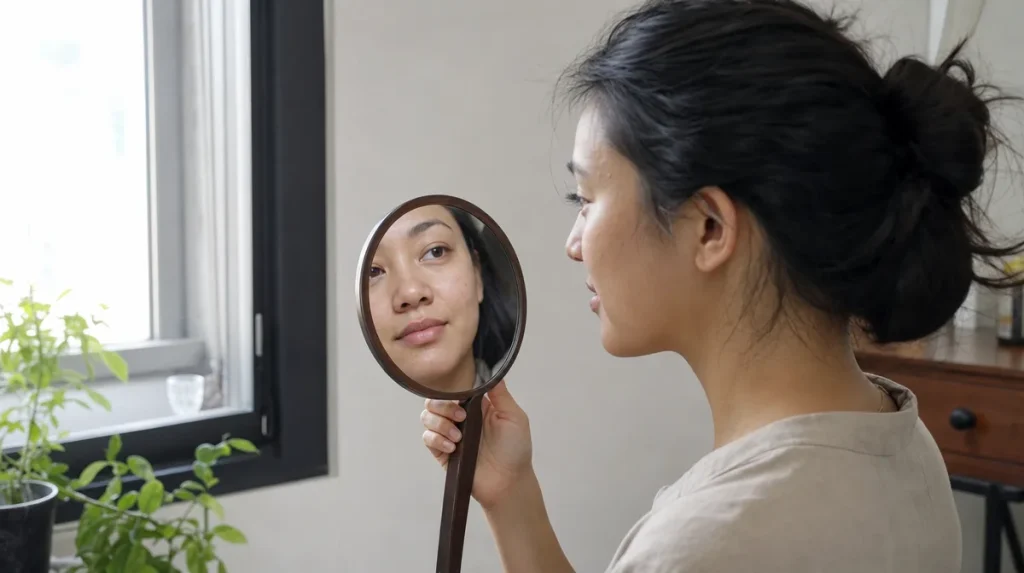
Lash hair has no living cells, so once mascara is applied, what happens to it over the day comes down to oil, humidity and gravity. Sebum from the lash line travels up the hair shaft the same way water climbs a paper towel, softening the coating and letting lashes droop under their own slight weight. In humid weather, or a hot commute, this happens faster.
A 2023 study in the Journal of Cosmetic Science measured mascara film integrity over an eight-hour wear period and found that flexibility of the dried film, not just its initial thickness, predicted how well volume held through the day. A stiff, brittle film looked dramatic at nine and cracked by noon. A more flexible one held shape longer, even with a slightly lighter first application.
The practical takeaway is that volume is not just about how much product goes on, it is about how the dried film behaves for the rest of the day. Touch-ups matter less than people think if the base application was done with a formula and technique that flexes rather than cracks.
Loading The Wand Without Overloading It
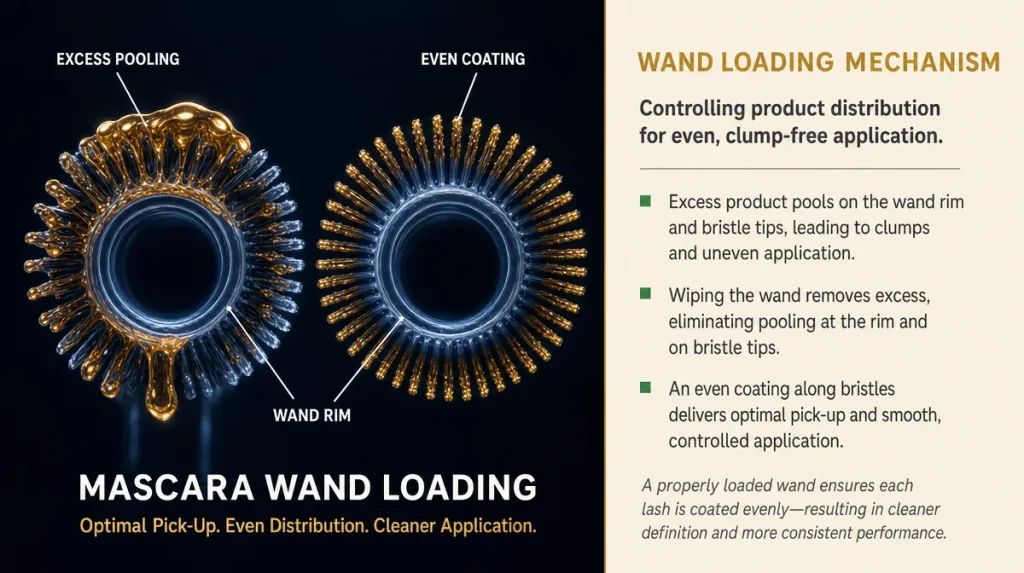
Think of the wand the way a house painter thinks of a brush: dip too deep and the extra paint drips and pools, dip too shallow and the coverage goes patchy. Most people pull the wand straight out of the tube and apply immediately, carrying far more product on the bristles than the lash line needs for the first coat.
A better method is to wipe one side of the wand against the inner rim of the tube before the first pass. This removes the excess that would otherwise sit in clumps at the lash tips. The remaining product is usually still plenty for full coverage at the root, where volume actually reads visually.
A common mistake is judging the wand by how loaded it looks rather than how it performs. A heavily coated wand looks generous but tends to deposit unevenly, building thick patches in the centre of the lash line and leaving the outer corners bare. Wiping down first, then building with thin passes, produces a more even result and, over repeated applications, less product waste.
Starting At The Root Without Stabbing Your Lid
Volume comes from the base of the lash, not the tip. This is where most of the visual density lives, because that is where the eye reads thickness against the skin. Applying mascara only along the top two-thirds of the lash, which is the easier motion, skips the part that actually builds the illusion of fuller lashes.
The wiggle motion recommended in most tutorials exists for a mechanical reason: it separates lash hairs that clump together naturally and coats each one individually rather than gluing several together into one thick strand. Done well, the wand tilts nearly flat against the lash line, moves in small side to side motions at the base, then sweeps upward and out in one continuous stroke.
The mistake that causes most eyelid smudging is starting too close to the skin and pressing the wand directly against the lid rather than the lash base itself. This deposits product on skin rather than hair, which later transfers as smudging under the eye. A gentler starting point, a millimetre or two above the lid, avoids this without sacrificing root coverage.
Curling Before Product, Never After
The order of curling versus mascara application changes the final shape, and it is worth understanding why. An eyelash curler works by temporarily reshaping the hair’s internal structure through pressure, similar to how a hair straightener works on scalp hair, though with much less heat involved in most curlers sold without a heated element.
Once mascara has dried, the hair shaft is coated in a stiffer film. Curling after this point risks snapping lashes at the crease point of the curler rather than bending them, because the dried coating resists the reshaping the curler is trying to do. Curling before any product goes on allows the natural curl to set first, and the mascara then locks that shape in rather than fighting it.
A frequently seen mistake is curling midway through applying several coats, hoping to fix a lash that has started to droop. This usually breaks the coating unevenly and can pull out a few lashes at the root over time. If a curl has dropped by midday, it is more reliably fixed by a fresh light coat than by re-curling over set product.
Letting Each Coat Actually Dry Before The Next
Two coats applied one right after another, while the first is still wet, tend to merge into a heavier, clumped mass rather than building clean layers. This is the same reason a second coat of wall paint needs time before the next: applying wet over wet just moves material around rather than adding a distinct layer.
Most mascara films need somewhere between twenty and forty seconds to set enough for a second pass to add rather than disturb. In practice, this means applying one eye, moving to the other eye, then returning to the first for the second coat. By the time the second eye is done, the first has usually had enough time to set.
A mistake many people repeat daily is applying three or four coats back to back within a few seconds, chasing volume that never quite arrives because each new pass partially lifts the previous one. If volume looks insufficient after a properly timed two coats, a lighter third coat applied only at the roots, once the first two have fully dried, tends to add density without the clumping.
Reading A Wand Shape Instead Of The Marketing On The Box
Wand shape has more influence on final volume than most of the language printed on mascara packaging. A tightly packed, small brush tends to concentrate product and build thickness quickly, useful for shorter lashes. A larger, more spaced-out bristle pattern distributes product more thinly across a wider lash fan, which favours length and separation over sheer density.
Terms like fibre-infused, buildable or extreme volume describe intent, not guaranteed outcome, and the same claim can perform very differently depending on wand design and how the product is applied. Fibre additives, when present, add microscopic length to the tip of the lash hair, but they can also clump if applied heavily or not brushed through while still wet.
A more reliable approach at the counter, where testing is possible, is to look at the wand itself before reading the front of the box: dense and tapered bristles for volume-focused wear, wider spaced bristles if separation and a natural look matter more. Editors at Canadian beauty titles like Chatelaine and ELLE Canada have both noted in seasonal beauty coverage that wand shape, more than ingredient lists, tends to determine how a mascara actually wears through the day.
Judging Results Honestly: Day One Versus Week Two
The first application of a new mascara is not always a fair test of how it performs. Lashes coated for the first time in a while often look dramatically different simply because they have not been coated recently, regardless of the formula’s real strengths.
A more honest read comes after five to seven wears, once technique has settled into a routine and any initial excitement has faded. At that point, questions worth asking are whether lashes still look separated by the end of the day, whether any flaking has appeared under the eyes by afternoon, and whether the curl from the morning has held without a touch-up.
A common mistake is abandoning a mascara after one underwhelming morning, when the issue was more likely wand technique or a rushed second coat than the formula itself. Conversely, a mascara that still looks heavy and separated after a full day, five days in a row, is a genuinely useful signal, one worth more than any claim printed on the packaging.
Removing Mascara Without Thinning Out Your Lash Line
How mascara comes off matters as much as how it goes on, because dried mascara film clings to the lash hair tightly enough that scrubbing or pulling at it can take a few lashes out at the follicle each time. Over months, this adds up to visibly thinner lash lines that people often attribute to age or genetics rather than removal habit.
The Canadian Dermatology Association’s general public guidance on eye-area skincare recommends gentle, non-rubbing removal methods for the eye area given how thin and sensitive that skin is compared with the rest of the face. In practice for mascara, this means soaking a cotton pad with remover and holding it against closed lashes for several seconds before wiping, rather than scrubbing immediately.
A frequent mistake is skipping removal on nights when the makeup does not look heavy, on the assumption that a light day of wear does not need proper removal. Left on overnight, dried mascara continues to stiffen the lash shaft, and rubbing it off in a groggy morning routine is often rougher than an evening removal would have been.
Key Takeaways
Volume from mascara is mostly won or lost in application technique, not in the tube itself. Wipe the wand before the first coat, work from the root with a wiggling motion, curl before applying anything, let coats dry between passes, and judge a formula honestly over a week rather than a single morning. Gentle, soak-first removal protects the lash density you already have, which matters more over months than any single application.
A Quick Checklist Before Your Next Application
- Curl lashes first, before any product touches them.
- Wipe one side of the wand against the tube rim before the first coat.
- Start at the root with small side-to-side motions, then sweep upward.
- Wait twenty to forty seconds before a second coat.
- Judge a new mascara after five to seven wears, not one.
- Remove with a soaked pad held against closed lashes, never scrubbed.
This article is provided for general information only and is not a substitute for advice from a qualified professional.
Individual results from any technique or product may vary.