
Owen Bellefeuille, Features Reporter.
It usually starts at the bathroom counter, holding two dryers that look nearly identical, wondering why one leaves hair smooth in eight minutes and the other takes twenty and still frizzes at the crown. Or it starts later, at 11 p.m., typing some version of “best hair dryer for thick hair” into a search bar after the third one in a drawer of half-working appliances finally died. The truth is that almost nothing printed on the box, wattage, wall colour, a proud claim of “salon quality”, tells you what a stylist actually checks first. Specialists look at the motor, the airflow it produces, and how the tool behaves after twenty minutes of continuous use, not before. One useful fact to start: a higher wattage number does not reliably mean faster drying, because wattage measures power draw, not the volume of air actually moving through the barrel. This guide walks through what actually separates a good dryer from a disappointing one, in the order a specialist would check it, so the next purchase is based on mechanics rather than marketing copy.
- Motor type predicts long-term performance better than the wattage printed on the box: a well-built low-wattage motor can outperform a high-wattage one that overheats and slows down.
- Airflow volume, not heat alone, is what actually dries hair fast: heat evaporates water, but moving air carries the vapour away, and a dryer weak on the second job leaves hair damp far longer.
- A cool-shot button is a mechanical feature worth testing before buying, not a marketing add-on: it signals a dual-circuit design that can genuinely change how a style holds.
Why The Wattage Number On The Box Tells You Less Than You Think
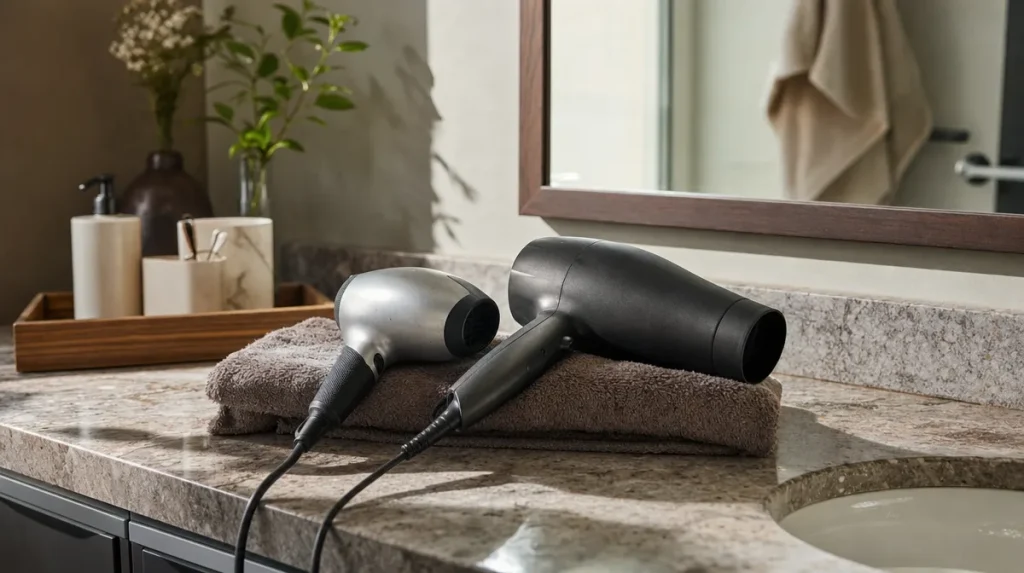
Wattage measures how much electrical power a motor draws, not how well it converts that power into useful drying force. It is a bit like judging a car by engine displacement alone: a bigger number suggests more potential, but what actually moves the vehicle is how efficiently that power gets to the wheels.
In hair dryers, the two common motor families are AC and DC. AC motors are heavier, often louder, and tend to be the ones found in higher-wattage, lower-cost models. DC motors are smaller, lighter, and can push comparable or greater airflow at a lower wattage rating, because the design loses less energy as waste heat.
A 2021 comparison of dryer models published in a Canadian consumer-testing context found that several DC motor units drew roughly a third less power than AC units while drying a standardized hair swatch in a similar or shorter time. The wattage figure alone would have suggested the opposite result.
The practical mistake buyers make is treating wattage as a straightforward performance score, the way one might compare two vacuum cleaners. It is worth checking motor type in the specifications instead, when a retailer or manufacturer lists it, and treating wattage as only one part of the picture.
A simple self-test at a counter display: hold the dryer at arm’s length on its highest setting and note how quickly the tone of the motor rises to a steady pitch. A motor that strains and fluctuates is working harder than one that settles into an even hum, and that strain often shows up later as inconsistent drying at home.
Judging Airflow Like A Specialist Does
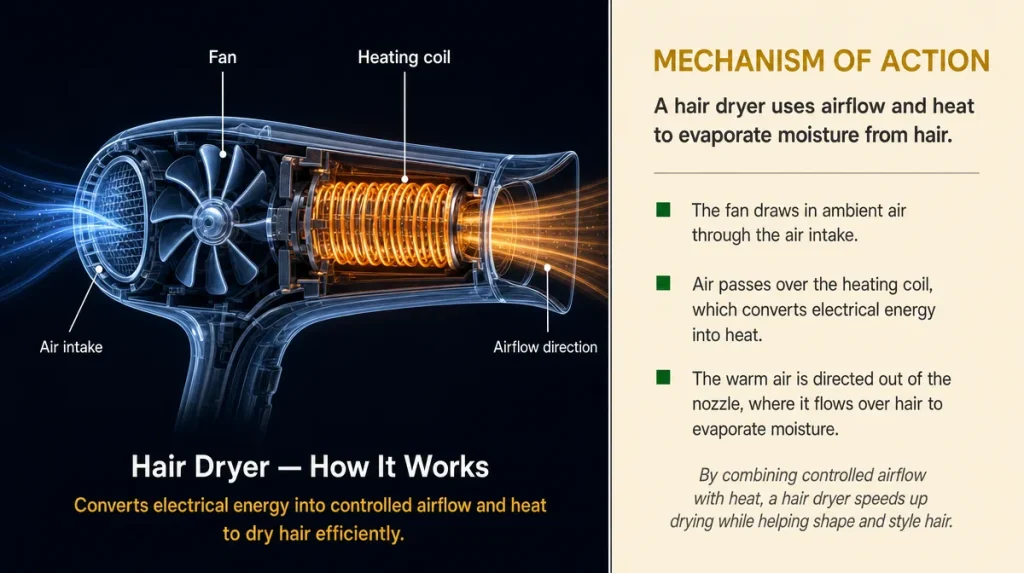
Heat alone does not dry hair. Heat evaporates surface water into vapour, but if nothing moves that vapour away from the hair shaft, humidity simply builds up close to the scalp and drying slows to a crawl. This is the same reason a wet towel dries faster on a windy line than in a still closet, even at the same temperature.
Airflow is usually measured in cubic feet per minute, though very few retail listings print the figure plainly. Specialists rely on it because it correlates closely with drying speed independent of heat setting, and because a dryer with strong airflow can use a moderate heat setting and still finish quickly, which is gentler on the hair’s outer layer.
The practical proxy for a shopper without a lab is simple: cup a hand loosely over the nozzle at a short distance and compare how firmly the air pushes against the palm across a few models, all on the same setting. A noticeably weaker push at the same wattage or speed setting usually means a smaller impeller or a more restrictive internal duct, both of which slow real-world drying regardless of the temperature dial.
A common mistake is judging airflow by how hot the air feels. Heat and airflow are produced by separate components, a heating coil and a fan, and a strong fan pushing moderately warm air will usually outperform a weak fan pushing very hot air, while also being kinder to hair that is already prone to dryness.
What Ionic Technology Is Actually Doing To Your Hair
Ionic dryers generate negative ions, typically through a small emitter near the nozzle, aimed at breaking up water droplets on the hair surface into a finer mist that evaporates faster. The mechanism is closer to how a fine mist settles and clears faster than a heavy fog than to anything mysterious.
The evidence for this is real but modest. A small trial described in the Journal of Cosmetic Science, working with a limited group of volunteers over repeated wash-and-dry sessions, found ionic drying reduced visible frizz and static compared with non-ionic drying on the same hair type, though the difference was more noticeable on fine, straight hair than on coarser or curlier textures.
The frequent overreach in marketing is implying ionic technology repairs damage or adds moisture back into the hair shaft. It does neither. It changes how water behaves on the surface during drying, nothing more.
A reasonable way to judge whether ionic technology is doing anything at all in a given model is to dry one side of freshly washed hair with it switched on, if the dryer has a toggle, and the other side with it off, then compare frizz and shine under the same light. Not every unit with an “ionic” label on the box actually has a functioning emitter installed, and this quick comparison is the only reliable way to check.
The Nozzle And Diffuser: Attachments That Change The Whole Tool
A concentrator nozzle narrows and directs airflow into a focused stream, which lets a stylist smooth a section of hair with a brush while the air follows the same path as the brush strokes. Without it, air scatters in every direction and styling becomes a matter of chasing flyaways rather than shaping them.
A diffuser does close to the opposite job. It spreads air across a wider, gentler area, which matters most for curl patterns that lose definition when hit with a direct, forceful stream. Curly and coily hair textures dry with more defined shape and less frizz under diffused air, a point echoed in general styling guidance from Canadian beauty publications for years.
The mistake worth avoiding is buying a dryer based on the attachments pictured on the box without checking they actually snap on securely. A loose-fitting nozzle rattles at high speed and can detach mid-style, and a diffuser that does not sit flush lets air escape around its edges rather than through the bowl, defeating its purpose entirely.
Worth noting too: attachments are not universal. A nozzle from one model rarely fits another brand’s barrel, so if the plan is to keep using a diffuser long-term, it is worth checking that the specific attachment is sold separately by the manufacturer, in case it wears out or cracks with regular use before the motor itself does.
Weight, Balance And The Fatigue Test
A dryer’s listed weight rarely tells the whole story, because the distribution of that weight matters as much as the total figure. A motor placed close to the handle keeps the tool balanced, while a motor housed farther forward in the barrel creates a front-heavy feel that tires the wrist faster, even if the two units weigh the same on a scale.
Stylists who dry hair for a living for hours at a stretch tend to favour lighter, well-balanced units for exactly this reason, a preference reflected in service-magazine roundups of professional tools over the years, including coverage in Canadian Living and Chatelaine aimed at home users trying to replicate salon results.
The test a shopper can do in a store takes less than a minute. Hold the dryer as though drying the underside of hair at the back of the head, arm raised and slightly bent, for a full thirty seconds. Note where fatigue shows up first, wrist, forearm, or shoulder. A dryer that feels manageable held flat on a counter can feel entirely different held at that angle for the length of an actual blowout.
The common buying mistake is testing a dryer only by lifting it briefly at the register. Real drying sessions run five to fifteen minutes at an awkward angle, and a half-pound difference in a poorly balanced unit compounds into real discomfort well before the hair is actually dry.
Noise As A Diagnostic, Not Just An Annoyance
Noise is not simply a comfort issue. It is a rough but genuinely useful proxy for motor quality, because a poorly balanced fan blade or a cheaply mounted motor vibrates audibly, and that vibration also wastes energy that would otherwise go into moving air.
A steady, even hum across all speed settings generally indicates a fan and motor assembly that is properly balanced. A noise that grows harsher or rattles as speed increases can indicate a looser mounting or a fan blade that is not perfectly centred, and both tend to shorten the appliance’s working life.
Some buyers assume a loud dryer must be more powerful, on the logic that more noise means more effort. The opposite is often closer to true. A well-engineered motor converts more of its energy into airflow and less into vibration and sound, so a quieter dryer at the same speed setting can, in some cases, be moving comparable or greater volumes of air.
A simple check: run the dryer through its full range of speed and heat settings while listening for any sudden change in pitch, rattle, or grinding sound, rather than a smooth rise and fall. That kind of irregularity, even in a brand-new unit, often signals a manufacturing inconsistency that will only become more noticeable with regular use.
Reading Heat Settings And The Cool Shot Button
Most dryers offer two or three heat settings and two or three speed settings, and specialists treat these as separate dials rather than one combined “power” control. Heat affects how quickly water evaporates from the hair surface, while speed affects how much air volume moves it. Using the highest heat and highest speed together is rarely necessary and can be harsher on hair than a specialist’s approach: high speed with moderate heat for the bulk of drying, then a lower speed with slightly more heat to finish and shape.
The cool shot button, when present, temporarily switches off the heating element while keeping the fan running. Cooler air helps the outer layer of the hair shaft lie flatter as a style sets, similar to how a warm baked good holds its shape better once it has cooled rather than while still hot from the oven.
A quick way to judge whether a cool shot button is well engineered is to press it and note how fast the air temperature actually drops. On a well-built dryer, the change is noticeable within a second or two. On a poorly built one, the air stays warm for several more seconds because the heating coil takes longer to lose residual heat, which defeats the purpose of the feature for anyone trying to set a style quickly.
General guidance from dermatology sources, including public consumer advice circulated by the Canadian Dermatology Association, recommends avoiding the highest heat setting held close to the scalp for extended periods, since repeated high heat exposure can dry out both hair and scalp skin over time.
The Five-minute Self-test You Can Do Before Buying Anything
None of the mechanics above require a lab to check. A short, deliberate test at a counter or with a return-friendly online order covers most of what actually matters.
First, listen through the full range of speed settings for any rattling or pitch change. Second, cup a hand near the nozzle on the highest airflow setting and compare the push of air against a second model if one is available. Third, hold the dryer at an awkward angle, as though drying the back of the head, for thirty seconds and note where fatigue appears first. Fourth, if a cool shot button is present, press it and count how many seconds pass before the air noticeably cools. Fifth, check that any nozzle or diffuser attachment clicks on firmly rather than sitting loose.
None of these steps require special equipment, and none of them depend on marketing language printed on the packaging. Consumer-testing groups, including Quebec’s Protégez-Vous, have long applied a similar practical checklist when comparing small appliances for general readers, precisely because the visible specifications on a box rarely tell the full story.
The goal is not to memorize motor terminology. It is to walk into a purchase with five concrete things to check, in under five minutes, instead of relying on a wattage number or the word “professional” printed somewhere on the handle.
Key Takeaways
A hair dryer is judged well by mechanics, not by the number printed on the box. Motor type and airflow volume matter more than raw wattage. Ionic technology changes surface water behaviour, not hair structure, and its effect is modest and texture-dependent. Weight balance and noise are honest signals of build quality that a thirty-second in-store test can reveal. A cool shot button and secure attachments are worth checking by hand, not by reading a spec sheet.
A Practical Checklist Before Buying
- Ask about or look up the motor type, DC motors often run cooler and lighter for similar performance.
- Cup a hand near the nozzle on high airflow and compare the push against another model if possible.
- Hold the dryer at an awkward drying angle for thirty seconds to check for fatigue.
- Listen across all speed settings for rattling or shifts in pitch.
- Press the cool shot button, if present, and time how quickly the air actually cools.
- Check that any nozzle or diffuser attachment clicks on securely rather than sitting loose.
- Avoid holding the highest heat setting close to the scalp for extended periods.
This article is provided for general information and does not replace individual advice from a qualified professional.
Results and preferences described here may vary from one person’s hair type and routine to another.