


Owen Bellefeuille, Features Reporter.
You already know the moment. Nine in the morning the line looks crisp. By the time you catch yourself in the elevator mirror at lunch, it has migrated into the crease, or there is a grey smudge sitting under your left eye like a bruise. The bathroom drawer fills up with half-used pens that promised the opposite. Before buying the next one, it helps to know what actually makes a liner hold, because the answer has very little to do with the word printed on the front of the box. One useful fact to start: the skin on the eyelid produces more oil per square centimetre than almost anywhere else on the face, which is the real reason most eyeliners fail before anything else does.
- Transfer resistance and smudge resistance are not the same claim, and a liner can pass one test while failing the other.
- Applicator shape affects staying power as much as the formula does, because thin, controlled lines hold up better than thick ones.
- How a liner comes off tells you how it behaved all day, since formulas that resist water usually resist gentle removal too.
Why Your Eyeliner Moves By Noon

Eyelid skin is thinner than skin almost anywhere else on the body, and it sits close to active oil glands. Through the day, that oil rises to the surface the way moisture rises through a damp sidewalk, lifting whatever sits on top of it. A liner formula is essentially trying to stick pigment to that surface and stay put despite the oil working against it. This is why a liner can test beautifully in a cool, dry store and fail within hours on an actual face. Heat from body temperature softens waxes and resins in the formula, the same way a crayon softens in a warm car. Blinking roughly fifteen to twenty times a minute adds mechanical friction on top of that. The takeaway is not that your skin is the problem. It is that any formula claiming all-day wear needs to survive oil, heat and movement at once, not just one of the three.
Reading The Label Without The Marketing Noise
“Waterproof,” “transfer-resistant” and “24-hour wear” sound like fixed standards. They are not. There is no single regulated test that every brand must pass before using these words in Canada, which is why results vary so widely from one liner to the next. A 2021 study published in the International Journal of Cosmetic Science compared several products marketed as waterproof and found meaningful differences in how long each one actually resisted water immersion, from under thirty minutes to well over two hours. The label told buyers almost nothing about where their specific product would land. “Transfer-resistant” is a narrower, more honest claim than “waterproof.” It generally means the formula resists rubbing off on skin, fabric or glasses, which matters more for daily wear than resistance to actual submersion. If a box lists both terms, the transfer claim is usually the more reliable one to weigh.
Felt Tip, Brush Or Gel Pot: What The Applicator Changes
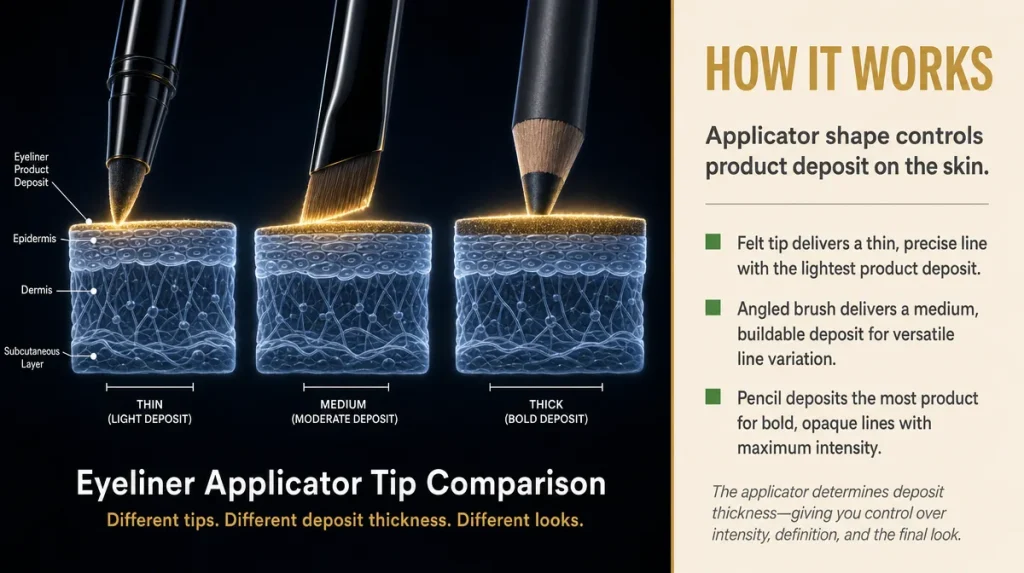
The tip shape decides how much product lands on the lash line and how thick that line sits, and both of those decide how long it survives the day. A fine felt tip or a tapered brush deposits a thin, controlled layer. A thicker pencil or a loaded brush from a gel pot tends to lay down more product than the skin can hold onto. Think of painting a thin coat of varnish versus a thick one on a windowsill. The thin coat dries fast and bonds evenly. The thick coat stays tacky longer and is far more likely to smear if touched before it has fully set. Felt-tip and liquid pens generally set fastest because their formulas are thinner to begin with. Gel and cream formulas applied with a brush take longer to set but can be built up for a bolder line, which trades some wear time for more control over shape.
The Five-Minute Mirror Test
Before buying, most counters will let you draw a short test line on the back of the hand or along the wrist, where skin oil and texture roughly mimic the eyelid. Draw a line about two centimetres long, then set a timer for five minutes and do not touch it. At five minutes, press a clean tissue against the line without rubbing. A liner built to resist transfer will leave little to no colour on the tissue. One that smudges heavily at this stage, on skin that is cooler and less oily than an eyelid, is unlikely to hold through an afternoon. A second useful check: gently rub the line with a fingertip after it has dried. Formulas that flake into small dry particles rather than smearing into a smudge often contain a higher wax content, which tends to hold shape longer but can feel slightly stiff on the lid.
Where Cheaper Formulas Cut Corners
The visible difference between a budget liner and a higher-performing one usually comes down to two ingredients: pigment concentration and the quality of the film-forming wax or polymer used to bind that pigment to skin. Lower pigment load means the formula needs more product per stroke to look opaque, which means a thicker layer sitting on the lid, and thicker layers smudge more easily, as covered above. Cheaper binding agents can also separate over time inside the tube or pot, which is part of why a liner that worked well when new may perform worse six months later. None of this means an inexpensive liner cannot perform well. Formulation cost and shelf price do not move in a perfectly straight line. But a liner that feels gritty when applied, or that needs several passes to look solid, is very often compensating for a thinner pigment base with sheer volume of product, and that volume is exactly what works against all-day wear.
Judging Results Fairly Over A Full Day
A fair test runs a full day under conditions that resemble how the product will actually be worn, not a single glance in a cool bathroom at 8 a.m. Check the line at the four-hour mark, then again at eight hours if possible, noting whether it has faded evenly, migrated into the crease, or stayed largely intact. Humidity and activity level matter more than most people expect. A liner that performs well during a quiet office day may behave differently on a hot, humid afternoon outdoors, or during a workout. If your days vary a great deal, it is worth testing on both a calm day and a demanding one before judging a product as a failure. Oily eyelids, which are extremely common and not a flaw to correct, will always be the harder test case. If a liner holds reasonably well there, it will likely hold anywhere.
What Removal Tells You About The Formula
A liner that comes off instantly with a splash of water was probably never going to survive the day. One that needs vigorous rubbing with a cotton pad to budge is giving you information too, just at the other end of the day. General guidance from the Canadian Dermatology Association on eye makeup removal recommends gentle, non-rubbing motion with a dedicated remover, since repeated pulling at the thin skin around the eyes may contribute to premature fine lines and, over time, to lash loss at the root. If a liner reliably needs several passes of firm rubbing to remove, that same film-forming strength that kept it in place all day is working against the skin at night. A liner that releases with one or two gentle wipes using an oil-based remover, while still holding up to daytime transfer, is generally the better long-term balance.
Common Application Mistakes
Most wear failures trace back to application, not formula. Applying liner before an eye primer or setting powder has fully absorbed gives the pigment a slick, still-wet surface to slide on rather than bonding to skin. Pulling the eyelid taut while drawing the line is another common habit that works against wear. It can create a line that looks straight while the lid is stretched, then buckles and smudges once the lid relaxes back into its natural fold. Skipping a light dusting of translucent powder over naturally oily lids before lining removes a layer of grip the pigment needs. And switching products mid-season without re-testing is a quiet cause of disappointment: a formula that held up in a dry Canadian winter can behave quite differently in a humid July.
Key Takeaways
A long-wear claim on the box is a starting point, not a guarantee. Oil, heat and the thickness of the line you draw matter more than the word printed on the packaging. The applicator shape changes how much product sits on the lid, and a five-minute tissue test at the counter tells you more than any label. Removal difficulty is useful information too: a formula that comes off too easily likely will not last the day, while one that needs heavy rubbing may be harder on the skin over time.
A Quick Checklist Before You Buy
- Test a short line on the wrist and press a tissue to it after five minutes
- Rub the dried line gently with a fingertip to check for flaking versus smudging
- Note whether the applicator is a fine tip, a brush or a thicker pencil
- Ask how the product removes: a few gentle wipes is the target, not vigorous rubbing
- If your lids run oily, consider a light setting powder before lining
- Re-test any liner you love when the season or humidity changes
This article is for general information and does not replace advice from a dermatologist or other qualified health professional.
Individual results vary depending on skin type, application and environmental conditions.